

 PDF Version Demo
Refund in case of failure
We are committed to let all of the candidates pass Databricks exam and gain the IT certification successfully, but if you unfortunately failed the exam even with the help of Associate-Developer-Apache-Spark-3.5 exam questions: Databricks Certified Associate Developer for Apache Spark 3.5 - Python, we will promise a full refund for you, but you need to show your report card to us, and as soon as we confirm it we will give you a full refund, so just do not worry about your money of buying the Associate-Developer-Apache-Spark-3.5 study materials. What's more, you still have another choice, if you don’t want to choose a refund or have another exam, you can choose to ask another exam damp for free from us, we are still here and will try our best to give you the most effective help. Here, we want to say, our Associate-Developer-Apache-Spark-3.5 training materials can ensure you 100% pass, no help, full refund.
Enjoy one-year free update
In order to provide the latest and the most accurate Associate-Developer-Apache-Spark-3.5 study materials to customers, we will update our Associate-Developer-Apache-Spark-3.5 exam questions: Databricks Certified Associate Developer for Apache Spark 3.5 - Python regularly which covers all the keys points and the newest question types in the IT examination. After buying our Associate-Developer-Apache-Spark-3.5 training materials, you can enjoy one-year free update, our operation system will automatically send these latest and most accurate Associate-Developer-Apache-Spark-3.5 actual lab questions to your e-mail which you used to buy our products. And you just need to check your mailbox. If you are familiar with these key points and the new question types of the IT exam in our Associate-Developer-Apache-Spark-3.5 exam questions: Databricks Certified Associate Developer for Apache Spark 3.5 - Python and practice the questions in our materials there is no doubt that you can pass the IT exam and gain the Databricks certification easily.
Contact with our customer service staffs at any time
We believe that after-sale service plays a vital role in strengthening the bond between the company and customers, so we attach great importance to after-sale service for our customers. In order to provide better after sale service for our customers, our customer service agents will be available in twenty four hours, seven days a week, so after buying our Associate-Developer-Apache-Spark-3.5 exam questions: Databricks Certified Associate Developer for Apache Spark 3.5 - Python, if you have any question about Associate-Developer-Apache-Spark-3.5 study materials or the IT examination please feel free to contact with our customer service staffs at any time, we will be glad to provide service for you and will be patient to answer your questions about Databricks Certified Associate Developer for Apache Spark 3.5 - Python best questions and make every endeavor to solve your problems both before-sale and after-sale.
We all know that the IT exam is not easy but the Databricks certification is very important for IT workers so that many IT workers have to meet the challenge, and we aim to help you to pass the IT examination and gain the IT certification in a more efficient and easier way. Owing to its superior quality and reasonable price, our Associate-Developer-Apache-Spark-3.5 exam questions: Databricks Certified Associate Developer for Apache Spark 3.5 - Python have met with warm reception and quick sale in many countries. There are not only as reasonable priced as other makers, but our Associate-Developer-Apache-Spark-3.5 study materials are distinctly superior in the following respects.

Instant Download: Upon successful payment, Our systems will automatically send the product you have purchased to your mailbox by email. (If not received within 12 hours, please contact us. Note: don't forget to check your spam.)
Databricks Associate-Developer-Apache-Spark-3.5 Exam Syllabus Topics:
| Section | Weight | Objectives |
|---|---|---|
| Topic 1: Structured Streaming | 10% | - Defining streaming queries - Output modes and triggers - Streaming concepts and architecture - Fault tolerance and state management |
| Topic 2: Using Pandas API on Apache Spark | 5% | - Overview of Pandas API on Spark - Converting between Pandas and Spark structures - Key differences and limitations |
| Topic 3: Using Spark SQL | 20% | - Using catalog and metadata APIs - Integrating Spark SQL with DataFrames - Working with functions and expressions - Running SQL queries |
| Topic 4: Developing Apache Spark DataFrame API Applications | 30% | - Selecting, renaming, and modifying columns - Filtering, sorting, and aggregating data - Creating DataFrames and defining schemas - Reading and writing data in various formats - Handling missing values and data quality - User-defined functions (UDFs) - Partitioning and bucketing data - Joining and combining datasets |
| Topic 5: Apache Spark Architecture and Components | 20% | - Spark architecture overview - Fault tolerance and garbage collection - Execution and deployment modes - Execution hierarchy and lazy evaluation - Shuffling, actions, and broadcasting |
| Topic 6: Using Spark Connect to Deploy Applications | 5% | - Running applications via Spark Connect - Connecting to remote Spark clusters - Spark Connect architecture |
| Topic 7: Troubleshooting and Tuning Apache Spark DataFrame API Applications | 10% | - Optimizing transformations and actions - Debugging and logging - Managing memory and resource usage - Identifying performance bottlenecks |
Databricks Certified Associate Developer for Apache Spark 3.5 - Python Sample Questions:
1. 12 of 55.
A data scientist has been investigating user profile data to build features for their model. After some exploratory data analysis, the data scientist identified that some records in the user profiles contain NULL values in too many fields to be useful.
The schema of the user profile table looks like this:
user_id STRING,
username STRING,
date_of_birth DATE,
country STRING,
created_at TIMESTAMP
The data scientist decided that if any record contains a NULL value in any field, they want to remove that record from the output before further processing.
Which block of Spark code can be used to achieve these requirements?
A) filtered_users = raw_users.na.drop("all")
B) filtered_users = raw_users.na.drop("any")
C) filtered_users = raw_users.dropna(how="all")
D) filtered_users = raw_users.dropna(how="any")
2. 15 of 55.
A data engineer is working on a Streaming DataFrame (streaming_df) with the following streaming data:
id
name
count
timestamp
1
Delhi
20
2024-09-19T10:11
1
Delhi
50
2024-09-19T10:12
2
London
50
2024-09-19T10:15
3
Paris
30
2024-09-19T10:18
3
Paris
20
2024-09-19T10:20
4
Washington
10
2024-09-19T10:22
Which operation is supported with streaming_df?
A) streaming_df.show()
B) streaming_df.filter("count < 30")
C) streaming_df.select(countDistinct("name"))
D) streaming_df.count()
3. A Spark developer wants to improve the performance of an existing PySpark UDF that runs a hash function that is not available in the standard Spark functions library. The existing UDF code is:
import hashlib
import pyspark.sql.functions as sf
from pyspark.sql.types import StringType
def shake_256(raw):
return hashlib.shake_256(raw.encode()).hexdigest(20)
shake_256_udf = sf.udf(shake_256, StringType())
The developer wants to replace this existing UDF with a Pandas UDF to improve performance. The developer changes the definition of shake_256_udf to this:CopyEdit shake_256_udf = sf.pandas_udf(shake_256, StringType()) However, the developer receives the error:
What should the signature of the shake_256() function be changed to in order to fix this error?
A) def shake_256(df: pd.Series) -> pd.Series:
B) def shake_256(df: pd.Series) -> str:
C) def shake_256(raw: str) -> str:
D) def shake_256(df: Iterator[pd.Series]) -> Iterator[pd.Series]:
4. A data engineer is streaming data from Kafka and requires:
Minimal latency
Exactly-once processing guarantees
Which trigger mode should be used?
A) .trigger(availableNow=True)
B) .trigger(processingTime='1 second')
C) .trigger(continuous='1 second')
D) .trigger(continuous=True)
5. In the code block below, aggDF contains aggregations on a streaming DataFrame: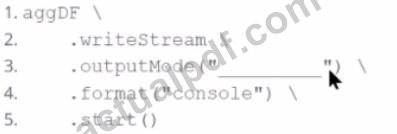
Which output mode at line 3 ensures that the entire result table is written to the console during each trigger execution?
A) replace
B) append
C) complete
D) aggregate
Solutions:
| Question # 1 Answer: D | Question # 2 Answer: B | Question # 3 Answer: A | Question # 4 Answer: B | Question # 5 Answer: C |


