

NSE7_PBC-6.4 Premium Exam Engine - Download Free PDF Questions
Instant Download NSE7_PBC-6.4 Free Updated Test Dumps
What is the duration, language, and format of the Fortinet NSE7_PBC-6.4 exam
Format: Multiple choices, multiple answers
- Language: English, French and Spanish.
- Number of Questions: 150
- Passing score: 75%
- Length of Examination: 3 hours
Features of Fortinet NSE7_PBC-6.4 Certification
The Fortinet NSE7_PBC-6.4 certification exam is designed for IT professionals who want to validate their skills in network security infrastructure. It tests your knowledge in the latest technologies and tools used in network and security operations. The Fortinet NSE7_PBC-6.4 certification enables you to obtain highly paid job opportunities and takes your career to new heights. It is very easy to prepare for Fortinet NSE7_PBC-6.4 certification exam in a short period of time. You can easily prepare for this exam with the help of this article. It contains many useful features and information for helping you to pass the NSE7_PBC-6.4 certification exam.
NEW QUESTION 13
When an organization deploys a FortiGate-VM in a high availability (HA) (active/active) architecture in Microsoft Azure, they need to determine the default timeout values of the load balancer probes.
In the event of failure, how long will Azure take to mark a FortiGate-VM as unhealthy, considering the default timeout values?
- A. 20 seconds
- B. 16 seconds
- C. 30 seconds
- D. Less than 10 seconds
Answer: C
NEW QUESTION 14
Which two statements about the Amazon Cloud Services (AWS) network access control lists (ACLs) are true?
(Choose two.)
- A. Network ACLs support allow rules and deny rules.
- B. Network ACLs must be manually applied to virtual network interfaces.
- C. Network ACLs are stateless, and inbound and outbound rules are used for traffic filtering.
- D. Network ACLs are stateful, and inbound and outbound rules are used for traffic filtering.
Answer: A,C
Explanation:
Explanation/Reference: https://docs.aws.amazon.com/vpc/latest/userguide/vpc-network-acls.html
NEW QUESTION 15
An Amazon Web Services (AWS) auto-scale FortiGate cluster has just experienced a scale-down event, terminating a FortiGate in availability zone C.
This has now black-holed the private subnet in this availability zone.
What action will the worker node automatically perform to restore access to the black-holed subnet?
- A. The worker node modifies the route table applied to the black-holed subnet changing its default route to point to a running FortiGate on the worker node's private subnet interface.
- B. The worker node applies a route table from a non-black-holed subnet to the black-holed subnet.
- C. The worker node moves the virtual IP of the terminated FortiGate to a running FortiGate on the worker node's private subnet interface.
- D. The worker node migrates the subnet to a different availability zone.
Answer: A
Explanation:
Explanation
Official documentation, failover process on a single AZ,
https://github.com/fortinet/aws-cloudformation-templates/blob/main/FGCP/7.0/SingleAZ/README.md#failove
|| Outbound failover is provided by reassigning the secondary IP addresses of ENI1\port2 from FortiGate 1's private interface to FortiGate 2's private interface. ##Additionally any route targets referencing FortiGate 1's private interface will be updated to reference FortiGate 2's private interface.##
https://github.com/fortinet/aws-cloudformation-templates/tree/master/LambdaAA-RouteFailover/6.0
NEW QUESTION 16
Customer XYZ has an ExpressRoute connection from Microsoft Azure to a data center. They want to secure communication over ExpressRoute, and to install an in-line FortiGate to perform intrusion prevention system (IPS) and antivirus scanning.
Which three methods can the customer use to ensure that all traffic from the data center is sent through FortiGate over ExpressRoute? (Choose three.)
- A. Enable the redirect option in ExpressRoute to send data center traffic to a user-defined route table
- B. Configure a user-defined route table
- C. Install FortiGate in Azure and build a VPN tunnel to the data center over ExpressRoute
- D. Configure the gateway subnet as the subnet in the user-defined route table
- E. Define a default route where the next hop IP is the FortiGate WAN interface
Answer: C,D,E
Explanation:
Explanation
https://docs.microsoft.com/en-us/answers/questions/618005/adding-a-inline-fw-to-express-route.html
NEW QUESTION 17
Refer to the exhibit.
In your Amazon Web Services (AWS) virtual private cloud (VPC), you must allow outbound access to the internet and upgrade software on an EC2 instance, without using a NAT instance. This specific EC2 instance is running in a private subnet: 10.0.1.0/24.
Also, you must ensure that the EC2 instance source IP address is not exposed to the public internet. There are two subnets in this VPC in the same availability zone, named public (10.0.0.0/24) and private (10.0.1.0/24).
How do you achieve this outcome with minimum configuration?
- A. Deploy a NAT gateway with an EIP in the public subnet, edit route tables, select Public-route, and delete the route destination 10.0.0.0/16 to target local.
- B. Deploy a NAT gateway with an EIP in the public subnet, edit route tables, select Private-route and add a new route destination 0.0.0.0/0 to target the NAT gateway.
- C. Deploy a NAT gateway with an EIP in the private subnet, edit the public main routing table, and change the destination route 0.0.0.0/0 to the target NAT gateway.
- D. Deploy a NAT gateway with an EIP in the private subnet, edit route tables, select Private-route, and add a new route destination 0.0.0.0/0 to the target internet gateway.
Answer: B
Explanation:
Explanation
AWS NAT gateway allows instances in a private subnet to connect to the internet or other AWS services without using NAT instance. the main routing table sends internet traffic from the private subnet instances to the NAT gateway, then NAT gateway sends traffic to the IGW using the source IP address of the elastic IP address.
Deploy a NAT gateway with an EIP in the public subnet, edit route tables, select Private-route and add a new route destination 0.0.0.0/0 to target the NAT gateway.
NEW QUESTION 18
Refer to the exhibit.
Consider an active-passive HA deployment in Microsoft Azure. The exhibit shows an excerpt from the passive FortiGate-VM node.
If the active FortiGate-VM fails, what are the results of the API calls made by the FortiGate named SSTENTAZFGT-0302? (Choose two.)
- A. 172.29.32.71 is set as a next hop IP for all routes under FortigateUDR-01
- B. SSTENTAZFGT-03-FloatingPIP public IP is assigned to NIC SSTENTAZFGT-0302-Nic-01
- C. SSTENTAZFGT-03-FloatingPIP is assigned to the IP configuration with the name SSTENTAZFGT- 0302-Nic-01, under the network interface SSTENTAZFGT-0302-Nic-01
- D. The network interface of the active unit moves to itself
Answer: A,C
NEW QUESTION 19
When configuring the FortiCASB policy, which three configuration options are available? (Choose three.)
- A. Data loss prevention policies
- B. Threat protection policies
- C. Intrusion prevention policies
- D. Antivirus policies
- E. Compliance policies
Answer: A,B,E
Explanation:
Explanation
Policy setting allows you to configure each policy to fit the need of your usage. You can select any type of Policy (Data Analysis, Threat Protection or Compliance)
https://docs.fortinet.com/document/forticasb/20.1.0/online-help/482958/policy-configuration
NEW QUESTION 20 
Refer to the exhibit. Consider an active-passive HA deployment in Microsoft Azure. The exhibit shows an excerpt from the passive FortiGate-VM node.
If the active FortiGate-VM fails, what are the results of the API calls made by the FortiGate named SSTENTAZFGT-0302? (Choose two.)
- A. SSTENTAZFGT-03-FloatingPIP public IP is assigned to NIC SSTENTAZFGT-0302-Nic-01
- B. The network interface of the active unit moves to itself
- C. 172.29.32.71is set as a next hop IP for all routes under FortigateUDR-01
- D. SSTENTAZFGT-03-FloatingPIP is assigned to the IP configuration with the name SSTENTAZFGT-
0302-Nic-01, under the network interface SSTENTAZFGT-0302-Nic-01
Answer: C,D
NEW QUESTION 21
You have been tasked with deploying FortiGate VMs in a highly available topology on the Amazon Web Services (AWS) cloud. The requirements for your deployment are as follows:
* You must deploy two FortiGate VMs in a single virtual private cloud (VPC), with an external elastic load balancer which will distribute ingress traffic from the internet to both FortiGate VMs in an active-active topology.
* Each FortiGate VM must have two elastic network interfaces: one will connect to a public subnet and other will connect to a private subnet.
* To maintain high availability, you must deploy the FortiGate VMs in two different availability zones.
How many public and private subnets will you need to configure within the VPC?
- A. One public subnet and one private subnet
- B. Two public subnets and one private subnet
- C. One public subnet and two private subnets
- D. Two public subnets and two private subnets
Answer: C
NEW QUESTION 22
Which three properties are configurable Microsoft Azure network security group rule settings? (Choose three.)
- A. Sequence number
- B. Source and destination IP ranges
- C. Destination port ranges
- D. Source port ranges
- E. Action
Answer: C,D,E
Explanation:
Explanation
Under "Default security rules" we read source, destination, source port, destination port and access. However under "Security rules" we read action, port ranges and source and destination, and essentially Options A, C, D and E are valid are those parameters can be configured. I would mark A D and E and source/destination port are to be seen in the table, maybe old documentation.
https://docs.microsoft.com/en-us/azure/virtual-network/network-security-groups-overview
NEW QUESTION 23 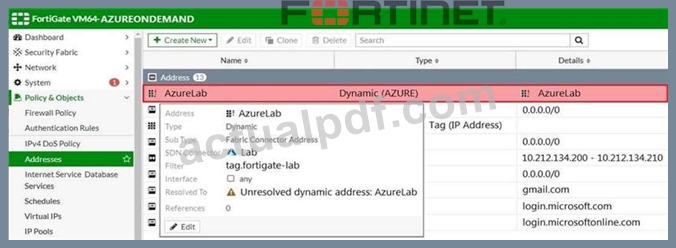
Refer to the exhibit. Your senior administrator successfully configured a FortiGate fabric connector with the Azure resource manager, and created a dynamic address object on the FortiGate VM to connect with a windows server in Microsoft Azure. However, there is now an error on the dynamic address object, and you must resolve the issue.
How do you resolve this issue?
- A. Run diagnose debug application azd -lon FortiGate.
- B. Delete the address object and recreate a new address object with the type set to FQDN.
- C. In the Microsoft Azure portal, access the windows server, obtain the private IP address, and assign the IP address under the FortiGate-VM AzureLab address object.
- D. In the Microsoft Azure portal, set the correct tag values for the windows server.
Answer: C
Explanation:
Explanation
NEW QUESTION 24
Your company deploys FortiGate VM devices in high availability (HA) (active-active) mode with Microsoft Azure load balancers using the Microsoft Azure ARM template. Your senior administrator instructs you to connect to one of the FortiGate devices and configure the necessary firewall rules. However, you are not sure now to obtain the correct public IP address of the deployed FortiGate VM and identify the access ports.
How do you obtain the public IP address of the FortiGate VM and identify the correct ports to access the device?
- A. In the configured load balancer, access the inbound and outbound NAT rules section.
- B. In the configured load balancer, access the inbound NAT rules section.
- C. In the configured load balancer, access the backend pools section.
- D. In the configured load balancer, access the health probes section.
Answer: A
NEW QUESTION 25
Refer to the exhibit.
The exhibit shows a topology where multiple connections from clients to the same FortiGate-VM instance, regardless of the protocol being used, are required.
Which two statements are correct? (Choose two.)
- A. The design shows an active-passive FortiGate-VM architecture.
- B. The design shows an active-active FortiGate-VM architecture.
- C. The Cloud Load Balancer Session Affinity setting should be changed to CLIENT_IP.
- D. The Cloud Load Balancer Session Affinity setting should use the default value.
Answer: B,C
Explanation:
Explanation
https://github.com/fortinet/fortigate-autoscale-gcp/blob/main/network.tf session_affinity = "CLIENT_IP" A - we using A-A architecture with GCP NLB B to ensure that the same client always reach the same machine regardless the protocol we must configure a session affinity that route the same source IP to the same instance as we can see in the TF deployment file
https://github.com/fortinet/fortigate-autoscale-gcp/blob/main/network.tf
"### Target Pools ###
resource "google_compute_target_pool" "default" {
name = "${var.cluster_name}-instancepool-${random_string.random_name_post.result}" session_affinity = "CLIENT_IP" health_checks = [
"${google_compute_http_health_check.default.name}",
]
}
"
NEW QUESTION 26
Which three properties are configurable Microsoft Azure network security group rule settings? (Choose three.)
- A. Sequence number
- B. Source and destination IP ranges
- C. Destination port ranges
- D. Source port ranges
- E. Action
Answer: C,D,E
NEW QUESTION 27
Which three properties are configurable Microsoft Azure network security group rule settings? (Choose three.)
- A. Sequence number
- B. Source and destination IP ranges
- C. Destination port ranges
- D. Source port ranges
- E. Action
Answer: C,D,E
Explanation:
Explanation/Reference: https://docs.microsoft.com/en-us/azure/virtual-network/network-security-groups-overview
NEW QUESTION 28 
Refer to the exhibit. Which two conditions will enable you to segregate and secure the traffic between the hub and the spokes in Microsoft Azure? (Choose two.)
- A. Use ExpressRoute to interconnect the hub VNets and spoke VNets.
- B. Implement the FortiGate-VM network virtual appliance (NVA) in the hub and use user-defined routes (UDRs) in the spokes.
- C. Configure VNet peering between the hub and spokes.
- D. Configure VNet peering between the spokes only.
Answer: A,C
NEW QUESTION 29
Refer to the exhibit.
Which two conditions will enable you to segregate and secure the traffic between the hub and the spokes in Microsoft Azure? (Choose two.)
- A. Use ExpressRoute to interconnect the hub VNets and spoke VNets.
- B. Implement the FortiGate-VM network virtual appliance (NVA) in the hub and use user-defined routes (UDRs) in the spokes.
- C. Configure VNet peering between the hub and spokes.
- D. Configure VNet peering between the spokes only.
Answer: A,C
NEW QUESTION 30
Refer to the exhibit.
Which two conditions will enable you to segregate and secure the traffic between the hub and the spokes in Microsoft Azure? (Choose two.)
- A. Use ExpressRoute to interconnect the hub VNets and spoke VNets.
- B. Implement the FortiGate-VM network virtual appliance (NVA) in the hub and use user-defined routes (UDRs) in the spokes.
- C. Configure VNet peering between the hub and spokes.
- D. Configure VNet peering between the spokes only.
Answer: B,C
NEW QUESTION 31
An organization deploys a FortiGate-VM (VM04 / c4.xlarge) in Amazon Web Services (AWS) and configures two elastic network interfaces (ENIs). Now, the same organization wants to add additional ENIs to support different workloads in their environment.
Which action can you take to accomplish this?
- A. Create the ENI, attach it to FortiGate, and then restart FortiGate.
- B. Create the ENI, shut down FortiGate, attach the ENI to FortiGate, and then start FortiGate.
- C. None, you cannot create and add additional ENIs to an existing FortiGate-VM.
- D. Create the ENI and attach it to FortiGate.
Answer: B
NEW QUESTION 32
Which two statements about the Amazon Cloud Services (AWS) network access control lists (ACLs) are true? (Choose two.)
- A. Network ACLs support allow rules and deny rules.
- B. Network ACLs must be manually applied to virtual network interfaces.
- C. Network ACLs are stateless, and inbound and outbound rules are used for traffic filtering.
- D. Network ACLs are stateful, and inbound and outbound rules are used for traffic filtering.
Answer: A,C
NEW QUESTION 33
......
Free NSE7_PBC-6.4 Exam Braindumps Fortinet Pratice Exam: https://pass4sure.actualpdf.com/NSE7_PBC-6.4-real-questions.html
