

First Attempt Guaranteed Success in PCNSE Exam 2024
Real PCNSE Exam Questions are the Best Preparation Material
The PCNSE exam is a comprehensive and challenging test that covers a wide range of topics, including firewall configuration, network security, virtualization, and cloud computing. PCNSE exam is based on the latest version of the Palo Alto Networks’ operating system, PAN-OS 10.0, which includes advanced security features such as machine learning, threat intelligence, and multi-cloud security. The PCNSE certification is recognized globally and is highly valued by employers, making it a valuable credential for security professionals looking to advance their careers in the cybersecurity industry.
The PCNSE certification is recognized as a standard of excellence for security professionals who work with the Palo Alto Networks platform. Palo Alto Networks Certified Security Engineer (PCNSE) PAN-OS 10.0 certification demonstrates that the candidate has a deep understanding of the platform's features and capabilities, and is able to configure and manage it effectively to protect against a wide range of threats. The PCNSE certification is also an essential requirement for many job roles in the field of network security, and is a valuable asset for anyone seeking to advance their career in this area.
NEW QUESTION # 28
What are three valid options when creating a new security policy? (Choose three.)
- A. Deny All
- B. Deny
- C. Alert
- D. Reset client
- E. Block
- F. Reset All
- G. Allow
Answer: B,D,G
Explanation:
NEW QUESTION # 29
An administrator has a PA-820 firewall with an active Threat Prevention subscription The administrator is considering adding a WildFire subscription.
How does adding the WildFire subscription improve the security posture of the organization1?
- A. WildFire and Threat Prevention combine to minimize the attack surface
- B. After 24 hours WildFire signatures are included in the antivirus update
- C. Protection against unknown malware can be provided in near real-time
- D. WildFire and Threat Prevention combine to provide the utmost security posture for the firewall
Answer: C
Explanation:
Explanation
Adding a WildFire subscription can improve the security posture of the organization by providing protection against unknown malware in near real-time. With a WildFire subscription, the firewall can forward various file types for WildFire analysis, and can retrieve WildFire signatures for newly-discovered malware as soon as they are generated by the WildFire public cloud or a private cloud appliance. This reduces the exposure window and prevents further infection by the same malware. References:
https://docs.paloaltonetworks.com/wildfire/9-1/wildfire-admin/wildfire-overview/wildfire-subscription
NEW QUESTION # 30
An administrator would like to determine which action the firewall will take for a specific CVE. Given the screenshot below, where should the administrator navigate to view this information?
- A. Exceptions lab
- B. The profile rule action
- C. CVE column
- D. The profile rule threat name
Answer: B
NEW QUESTION # 31
In the following image from Panorama, why are some values shown in red?
- A. us3 has a logging rate that deviates from the administrator-configured thresholds.
- B. sg2 session count is the lowest compared to the other managed devices.
- C. sg2 has misconfigured session thresholds.
- D. uk3 has a logging rate that deviates from the seven-day calculated baseline.
Answer: D
NEW QUESTION # 32
Refer to the exhibit.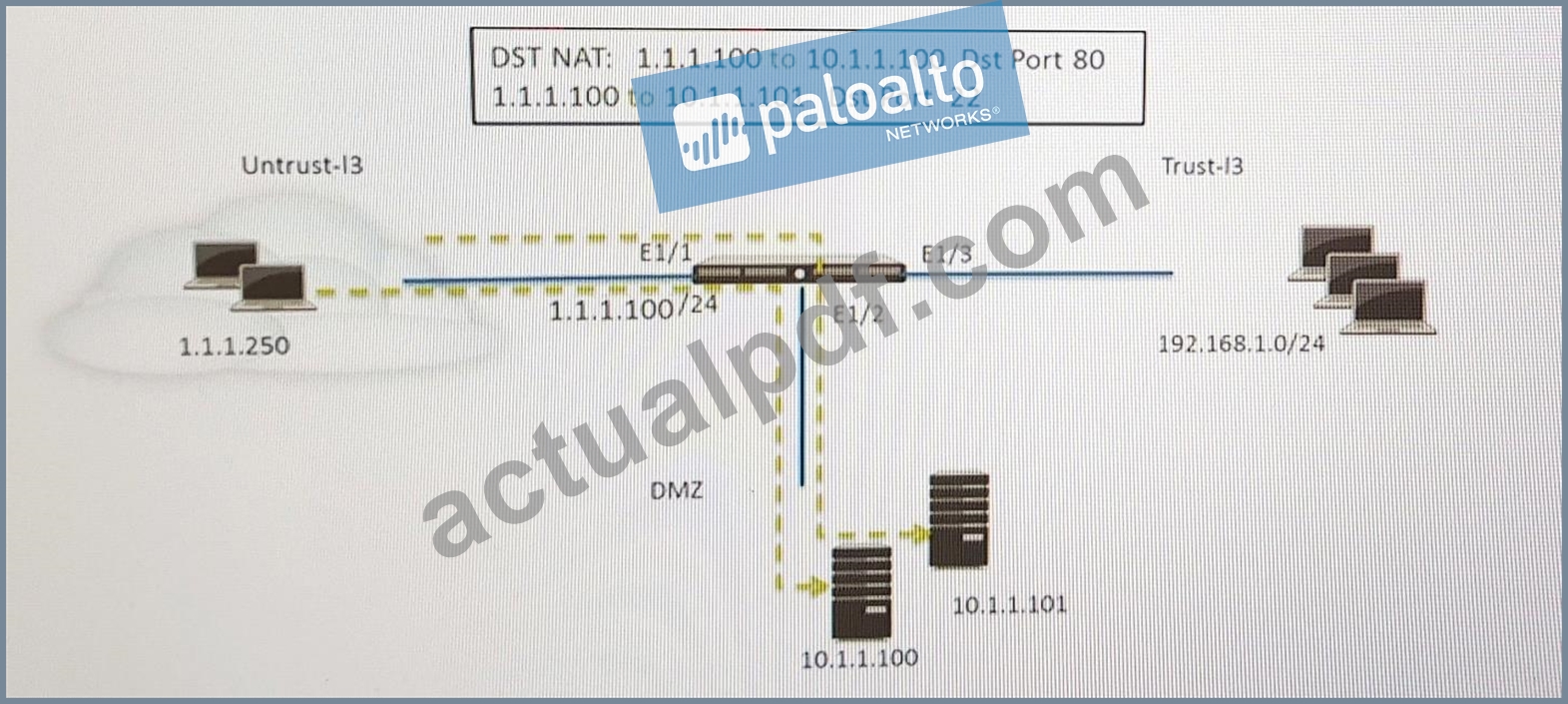
An administrator is using DNAT to map two servers to a single public IP address. Traffic will be steered to the specific server based on the application, where Host A (10.1.1.100) receives HTTP traffic and HOST B (10.1.1.101) receives SSH traffic.) Which two security policy rules will accomplish this configuration? (Choose two.)
- A. Untrust (Any) to DMZ (10.1.1.100.10.1.1.101), ssh, web-browsing -Allow
- B. Untrust (Any) to Untrust (10.1.1.1), SSH -Allow
- C. Untrust (Any) to DMZ (1.1.1.100), web-browsing -Allow
- D. Untrust (Any) to DMZ (1.1.1.100), SSH -Allow
- E. Untrust (Any) to Untrust (10.1.1.1), web-browsing -Allow
Answer: C,D
Explanation:
https://docs.paloaltonetworks.com/pan-os/8-0/pan-os-admin/networking/nat/nat-configuration-examples/destination-nat-exampleone-to-many-mapping#
NEW QUESTION # 33
An engineer is configuring a template in Panorama which will contain settings that need to be applied to all firewalls in production.
Which three parts of a template an engineer can configure? (Choose three.)
- A. Service Route Configuration
- B. NTP Server Address
- C. Authentication Profile
- D. Dynamic Address Groups
- E. Antivirus Profile
Answer: A,B,C
Explanation:
NTP Server Address D. Service Route Configuration Short Explanation of Correct Answer Only: These parts of a template can be configured on Panorama1. An antivirus profile and an authentication profile are not parts of a template, but parts of a device group2. Reference: 1: https://docs.paloaltonetworks.com/panorama/10-1/panorama-admin/manage-firewalls/manage-templates-and-template-stacks/templates-and-template-stacks-overview 2: https://docs.paloaltonetworks.com/panorama/10-1/panorama-admin/manage-firewalls/manage-device-groups/device-group-overview
NEW QUESTION # 34
Site-A and Site-B have a site-to-site VPN set up between them. OSPF is configured to dynamically create the routes between the sites. The OSPF configuration in Site-A is configured properly, but the route for the tunner is not being established. The Site-B interfaces in the graphic are using a broadcast Link Type. The administrator has determined that the OSPF configuration in Site-B is using the wrong Link Type for one of its interfaces.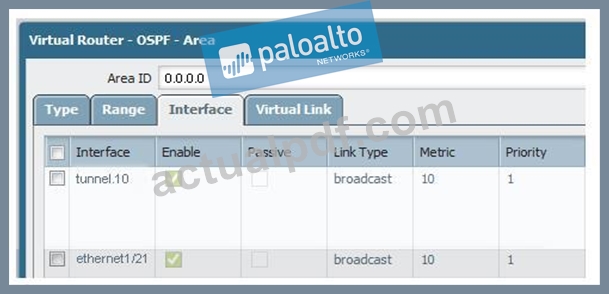
Which Link Type setting will correct the error?
- A. Set Ethernet 1/1 to p2mp
- B. Set Ethernet 1/1 to p2p
- C. Set tunnel. 1 to p2mp
- D. Set tunnel. 1 to p2p
Answer: D
NEW QUESTION # 35
A user's traffic traversing a Palo Alto Networks NGFW sometimes can reach http://www.company.com. At other times the session times out. The NGFW has been configured with a PBF rule that the user's traffic matches when it goes to http://www.company.com.
How can the firewall be configured automatically disable the PBF rule if the next hop goes down?
- A. Enable and configure a Link Monitoring Profile for the external interface of the firewall.
- B. Create and add a Monitor Profile with an action of Fail Over in the PBF rule in question.
- C. Configure path monitoring for the next hop gateway on the default route in the virtual router.
- D. Create and add a Monitor Profile with an action of Wait Recover in the PBF rule in question.
Answer: B
Explanation:
Explanation/Reference:
https://docs.paloaltonetworks.com/pan-os/8-0/pan-os-web-interface-help/network/network-network-profiles- monitor#
NEW QUESTION # 36
As a best practice, which URL category should you target first for SSL decryption*?
- A. Health and Medicine
- B. Online Storage and Backup
- C. High Risk
- D. Financial Services
Answer: C
Explanation:
Explanation
https://docs.paloaltonetworks.com/best-practices/10-0/decryption-best-practices/decryption-best-practices/plan-s Phase in decryption. Plan to decrypt the riskiest traffic first (URL Categories most likely to harbor malicious traffic, such as gaming or high-risk)
NEW QUESTION # 37
How can an administrator configure the NGFW to automatically quarantine a device using GlobalProtect?
- A. by using security policies, log forwarding profiles, and log settings.
- B. There is no native auto-quarantine feature so a custom script would need to be leveraged.
- C. by adding the device's Host ID to a quarantine list and configure GlobalProtect to prevent users from connecting to the GlobalProtect gateway from a quarantined device
- D. by exporting the list of quarantined devices to a pdf or csv file by selecting PDF/CSV at the bottom of the Device Quarantine page and leveraging the approbate XSOAR playbook
Answer: A
Explanation:
https://docs.paloaltonetworks.com/pan-os/10-0/pan-os-new-features/globalprotect-features/identification-and-quarantine-of-compromised-devices.html
https://docs.paloaltonetworks.com/globalprotect/10-1/globalprotect-admin/host-information/quarantine-devices-using-host-information/automatically-quarantine-a-device.html#idb42b2b82-b253-4be7-9840-1efa49dba3da
NEW QUESTION # 38
What are two best practices for incorporating new and modified App-IDs? (Choose two)
- A. Perform a Best Practice Assessment to evaluate the impact or the new or modified App-IDs
- B. Run the latest PAN-OS version in a supported release tree to have the best performance for the new App-IDs
- C. Configure a security policy rule to allow new App-lDs that might have network-wide impact
- D. Study the release notes and install new App-IDs if they are determined to have low impact
Answer: C,D
Explanation:
https://docs.paloaltonetworks.com/pan-os/10-2/pan-os-upgrade/software-and-content-updates/best-practices-for-app-and-threat-content-updates/best-practices-security-first#id184AH00F06E
NEW QUESTION # 39
Which statement about High Availability timer settings is true?
- A. Use the Recommended timer for faster failover timer settings.
- B. Use the Moderate timer for typical failover timer settings.
- C. Use the Critical timer for taster failover timer settings.
- D. Use the Aggressive timer for taster failover timer settings
Answer: A
Explanation:
Explanation
https://docs.paloaltonetworks.com/pan-os/10-2/pan-os-admin/high-availability/ha-concepts/ha-timers
NEW QUESTION # 40
An administrator has configured the Palo Alto Networks NGFW's management interface to connect to the internet through a dedicated path that does not traverse back through the NGFW itself.
Which configuration setting or step will allow the firewall to get automatic application signature updates?
- A. A service route will need to be configured.
- B. A Security policy rule will need to be configured to allow the update requests from the firewall to the update servers.
- C. A scheduler will need to be configured for application signatures.
- D. A Threat Prevention license will need to be installed.
Answer: C
NEW QUESTION # 41
A company needs to preconfigure firewalls to be sent to remote sites with the least amount of preconfiguration.
Once deployed, each firewall must establish secure tunnels back to multiple regional data centers to include the future regional data centers.
Which VPN configuration would adapt to changes when deployed to the future site?
- A. Preconfigured GlobalProtect satellite
- B. Preconfigured PPTP Tunnels
- C. Preconfigured GlobalProtect client
- D. Preconfigured IPsec tunnels
Answer: A
NEW QUESTION # 42
To ensure that a Security policy has the highest priority, how should an administrator configure a Security policy in the device group hierarchy?
- A. Add the policy in the shared device group as a pre-rule
- B. Add the policy to the target device group and apply a master device to the device group.
- C. Reference the targeted device's templates in the target device group.
- D. Clone the security policy and add it to the other device groups.
Answer: A
Explanation:
According to the Palo Alto Networks documentation1, the shared device group is a special device group that contains policies and objects that apply to all firewalls managed by Panorama. The policies in the shared device group can be configured as pre-rules or post-rules, which determine their priority relative to the policies in other device groups. Pre-rules have higher priority than the policies in other device groups, while post-rules have lower priority. Therefore, to ensure that a Security policy has the highest priority, the administrator should configure it in the shared device group as a pre-rule. Therefore, the correct answer is D.
The other options are not relevant or effective for ensuring that a Security policy has the highest priority:
Add the policy to the target device group and apply a master device to the device group: This option would add the policy to a specific device group, which is a subset of firewalls managed by Panorama. The policy would only apply to the firewalls in that device group, not to all firewalls. Moreover, applying a master device to the device group does not affect the priority of the policy, but only allows synchronizing configuration changes across devices in the same device group2.
Reference the targeted device's templates in the target device group: This option would reference the templates that contain network and device settings for the targeted devices in the target device group. It does not affect the Security policy or its priority, but only allows applying consistent configuration settings across devices in the same device group3.
Clone the security policy and add it to the other device groups: This option would create copies of the security policy and add them to different device groups. However, this would not ensure that the policy has the highest priority, because it would still depend on whether it is configured as a pre-rule or a post-rule within each device group. Moreover, this option would create redundant and potentially conflicting policies across different device groups.
NEW QUESTION # 43
Which CLI command is used to determine how much disk space is allocated to logs?
- A. debug log-receiver show
- B. show logging-status
- C. show system info
- D. show system logdfo-quota
Answer: D
Explanation:
https://knowledgebase.paloaltonetworks.com/KCSArticleDetail?id=kA10g000000ClgZCAS
NEW QUESTION # 44
......
Practice LATEST PCNSE Exam Updated 125 Questions: https://pass4sure.actualpdf.com/PCNSE-real-questions.html
